

The US Dietary Guidelines considers potassium a “nutrient of public health concern” because most Americans are falling short of the minimum daily requirement.
Potassium is best known for its role in muscle function, regulating blood pressure, preventing strokes and heart attacks, and reducing risk for type 2 diabetes. Potassium is the third most abundant mineral in the human body. There is 30 times more potassium inside the cell than outside. This difference creates an electrochemical gradient that determines the resting membrane potential throughout the central nervous system. Forty percent of the body’s total energy expenditure is used to maintain this electrochemical gradient. The rapid-fire transfer of potassium and other ions across neuronal cell membranes is essential for the transmission of electrical signals throughout the nervous system.
Humans must consume potassium from the diet in abundance, but most of us don’t consume enough.
Our paleolithic ancestors ate way more potassium than we do now. The old RDA for potassium set by the Food and Nutrition Board of the Institute of Medicine is 4,700mg/day. In 2019, the RDA for potassium was changed to 3,400mg/day for men and 2,600mg/day for women. The World Health Organization recommends 3,150mg/day (World Health Organization, 2012). The American Heart Association recommends at least 3,500mg/day of potassium as primary prevention for hypertension, which is well above the RDA (Chobanian et al., 2003).
On average, American adults consume less than 2,800mg of potassium per day (Fulgoni et al., 2011). We know that RDAs represent the bare minimum to prevent disease and often falls short of the optimal intake for good health. The optimal daily intake of potassium for most adults is probably somewhere between 3,500mg and 4,700mg per day. People with impaired kidney function may need to restrict their potassium intake.
Potassium deficiency can present with one or more of the following signs and symptoms:
- Fatigue
- Low stamina
- General weakness
- Lethargy
- Muscle cramps or twitches
- Shortness of breath
- Elevated heart rate
- Palpitations
- High blood pressure
- Lightheadedness
- Brain fog
- Insomnia
- Irritable mood
- Depressed mood
- Anxiety
- Tingling and numbness of the hands or feet
- Nausea and vomiting
- Bloating
- Constipation
High anxiety can precipitate acute potassium deficiency which can lead to physical symptoms that further exacerbate anxiety. I suspect potassium deficiency when patients complain of tense neck and shoulder muscles and general fatigue. They might complain of chronic low-level anxiety with episodic panic attacks that lead to transient tingling and numbness of their hands and feet, blood pressure spikes, a racing heart, and a feeling of heaviness over their chest. A closer look at their diet might reveal suboptimal potassium intake.
The best way to optimize your potassium levels is through diet. Here’s how to do it:
- Avoid processed foods and refined carbohydrates. Refined carbs are low in potassium and drive up the demand for potassium in the body.
- Consume a diet that is rich in real whole foods, including animal protein and at least 4 cups of fruit and vegetables every day.
- Beware of foods that are very high in oxalates (eg. spinach, kiwi, rhubarb, swiss chard, beet greens). These foods are rich in potassium, but their very high oxalate content make them a net negative to human health. Do not consume these foods in excess.
- Ensure that you are getting enough magnesium daily. Magnesium helps your cells hold onto potassium. It is difficult to get enough magnesium even with a healthy diet due to agricultural soil depletion. Supplementing with 120mg of magnesium glycinate once or twice a day is a good idea for most adults with normal kidney function. I personally take the one from the brand Pure Encapsulations.
Here’s a visual representation of what an adult would need to consume in one day to meet their potassium requirement.
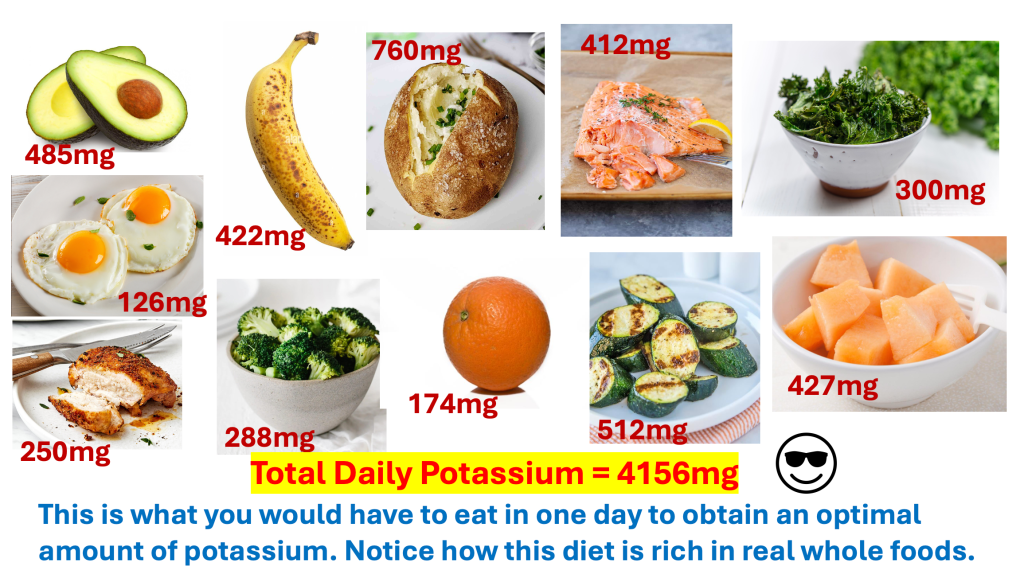
This is a lot of food. Eating to meet your potassium requirement will cause you to feel full and satiated each day. There won’t be much room for junk food!
Contrast this with this visual representation of the standard American diet in one day below.
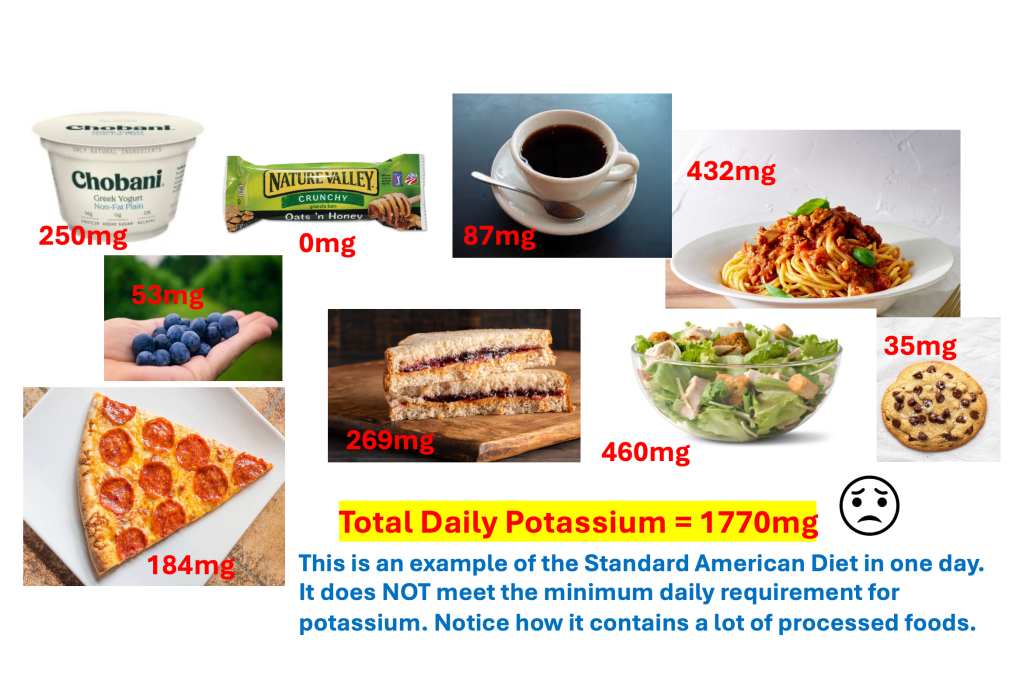
Given how foundational potassium is for human health, I was surprised to find out how little research exists about potassium’s impact on brain function and mental health. The limited studies that do exist suggest a bidirectional relationship between neuropsychiatric symptoms and low potassium.
Among healthy adults, there was an association between sleep problems and lower potassium intake, especially at dinner. Dietary potassium may be related to sleep quality (Okamoto et al., 2025). Lower potassium intake was associated with higher depression and anxiety scores in adults (Wu et al., 2023). Increasing potassium intake by up to 2300mg per day is associated with decreased depressive symptoms, with each extra 1000mg of potassium associated with a 3% decreased odds of depression (Huang & Huang, 2022). Higher potassium diet was associated with positive effects on overall mood (Torres et al., 2008). Lower potassium intake was associated with more severe depressive symptoms among urban low income adolescents (Mrug et al., 2019).
Emotional stress can cause serum potassium levels to drop acutely. Epinephrine (aka. adrenaline) is released by the adrenal glands during times of stress. Epinephrine causes an influx of potassium into skeletal muscles and a drop in serum potassium. Anesthesiologists have observed that anxiety felt by patients right before a planned surgery almost universally precipitates a drop in serum potassium. They are concerned about pre-op anxiety causing low potassium because this can encourage arrhythmias in the peri-induction phase of anesthesia. (McCleane & Watters, 1990).
Hypokalemia (or severe potassium deficiency) has been observed to occur more frequently in patients presenting with acute psychotic episodes (Hong, 2016). Patients presenting to the hospital for any psychiatric reason have higher rates of hypokalemia. This was especially true for suicide attempt, anorexia nervosa, alcohol withdrawal, psychosis, and major depressive disorder (the prevalence ranging from 22-45% (Kemperman et al., 1988). This was as high as that found in acute serious medical problems like heart attacks and strokes.
Addressing low dietary potassium is straightforward and easy. Before considering medications and nutraceuticals, we should first address the basics. Correcting low potassium intake with whole foods, at best, can produce rapid resolution of symptoms and at the very least, sets the foundation for total brain-body health from which we can build upon.
References
Chobanian, A. V., Bakris, G. L., Black, H. R., Cushman, W. C., Green, L. A., Izzo, J. L., Jones, D. W., Materson, B. J., Oparil, S., Wright, J. T., Roccella, E. J., Joint National Committee on Prevention, Detection, Evaluation, and Treatment of High Blood Pressure. National Heart, Lung, and Blood Institute, & National High Blood Pressure Education Program Coordinating Committee. (2003). Seventh report of the Joint National Committee on Prevention, Detection, Evaluation, and Treatment of High Blood Pressure. Hypertension (Dallas, Tex.: 1979), 42(6), 1206–1252. https://doi.org/10.1161/01.HYP.0000107251.49515.c2
Fulgoni, V. L., Keast, D. R., Bailey, R. L., & Dwyer, J. (2011). Foods, fortificants, and supplements: Where do Americans get their nutrients? The Journal of Nutrition, 141(10), 1847–1854. https://doi.org/10.3945/jn.111.142257
Hong, E. (2016). Hypokalemia and Psychosis: A Forgotten Association. American Journal of Psychiatry Residents’ Journal, 11(11), 6–7. https://doi.org/10.1176/appi.ajp-rj.2016.111103
Huang, A., & Huang, S. Y. (2022). Increasing Potassium Intake Up to 2300mg is Associated with Decreased Depressive Symptoms in United States Adults: Analysis of the National Health and Nutrition Examination Survey (NHANES) 2017-2020. In Review. https://doi.org/10.21203/rs.3.rs-2110891/v1
Kemperman, C. J. F., Kuilman, M., & Njio, L. K. F. (1988). A retrospective and explorative study of hypokalemia in psychiatric disorders: A beta2-receptor related phenomenon. European Archives of Psychiatry and Neurological Sciences, 237(3), 161–165. https://doi.org/10.1007/BF00451284
McCleane, G. J., & Watters, C. H. (1990). Pre-operative anxiety and serum potassium. Anaesthesia, 45(7), 583–585. https://doi.org/10.1111/j.1365-2044.1990.tb14837.x
Mrug, S., Orihuela, C., Mrug, M., & Sanders, P. W. (2019). Sodium and potassium excretion predict increased depression in urban adolescents. Physiological Reports, 7(16), e14213. https://doi.org/10.14814/phy2.14213
Okamoto, T., Lo, Y.-P., Khaing, I.-K., Inoue, S., Tada, A., Michie, M., Kubo, T., Shibata, S., & Tahara, Y. (2025). The Association of Sodium or Potassium Intake Timing with Athens Insomnia Scale Scores: A Cross-Sectional Study. Nutrients, 17(1), Article 1. https://doi.org/10.3390/nu17010148
Torres, S. J., Nowson, C. A., & Worsley, A. (2008). Dietary electrolytes are related to mood. British Journal of Nutrition, 100(5), 1038–1045. https://doi.org/10.1017/S0007114508959201
World Health Organization. (2012). Guideline: Potassium intake for adults and children. World Health Organization. https://iris.who.int/handle/10665/77986
Wu, Z., Heizhati, M., Hu, J., Lin, M., Gan, L., Li, M., Yang, W., Yao, L., Hong, J., Sun, L., Li, J., Li, W., & Li, N. (2023). Lower 24-h urinary potassium excretion is associated with higher prevalent depression and anxiety status in general population. Brain and Behavior, 13(4), e2842. https://doi.org/10.1002/brb3.2842
Medical Disclaimer: The information mentioned in this article is not intended to diagnose, treat, cure, or prevent any disease. The information provided is for educational purposes only and is not intended to replace the relationships with your medical provider(s). Before initiating any treatment, please first consult with your licensed medical provider.
 Brain Body Psychiatry