
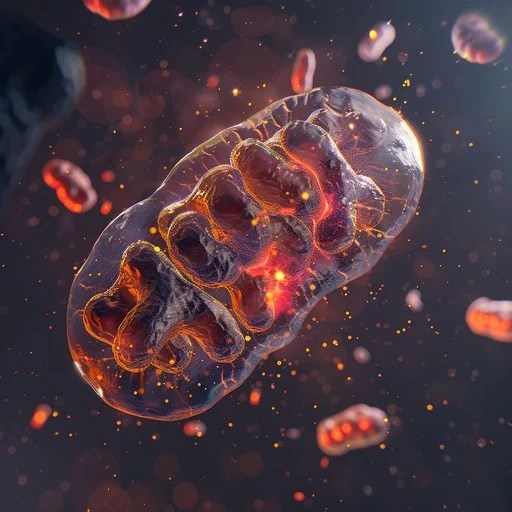
Mitochondrial function significantly impacts mental health, with growing evidence linking mitochondrial dysfunction to major depressive disorder (MDD), bipolar disorder, schizophrenia, anxiety disorders, ADHD, and autism spectrum disorder (ASD) [1-3]. Mitochondria are membrane-bound organelles known as the “powerhouses” of the cell. They generate most of the chemical energy needed to power the body’s biochemical reactions, in the form of a small molecule called adenosine triphosphate (ATP).
The brain, despite comprising only ~2% of body mass, consumes ~20% of total body energy, making it uniquely vulnerable to even subtle mitochondrial impairments. Impaired mitochondrial function is evident in depression, with mitochondria serving as a nexus within the psycho-immune-neuroendocrine (PINE) network. Autopsy studies confirm accumulation of abnormal mitochondria in the brains of depressed patients [4].
Patients with genetically confirmed primary mitochondrial disease have a strikingly high prevalence of psychiatric comorbidity — up to 70% in adults — with depression, anxiety, and cognitive impairment being the most common presentations [5, 6]. Current standard psychiatric medications also appear to have mitochondrial effects — lithium enhances autophagy (clearance of dysfunctional mitochondria and reverses mitochondrial complex abnormalities, and SSRIs may modulate mitochondrial pathways, though these are secondary mechanisms. [7-8]
The most important nutrients for mitochondrial function can be organized into two categories: vitamin-derived cofactors (especially B vitamins and CoQ10) that directly participate in the electron transport chain and TCA cycle, and essential minerals (iron, magnesium, selenium, and zinc) that serve as structural and catalytic cofactors for mitochondrial enzymes [9-11]. There are many more nutrient cofactors that support mitochondrial functioning that I won’t have time to go into here.
It is worth mentioning that exercise is one of the most potent stimuli for enhancing mitochondrial function, acting through four interconnected mechanisms: biogenesis (making more mitochondria), improved respiratory efficiency (making better mitochondria), remodeling of mitochondrial dynamics (fission, fusion, and mitophagy), and systemic signaling to non-muscle tissues including the brain [12-15]. I’ve had numerous patients report that they fell into a depressive episode shortly after sustaining an injury that left them unable to continue with their usual daily exercise.
In my practice, the most common deficiencies I encounter are shortages in B vitamins, zinc, iron, and magnesium – all of which directly impact mitochondrial functioning. I’ve observed rapid and noticeable results when correcting for these deficiencies. Research and my own observations have shown that B vitamins, in particular, can enhance a patient’s response to standard antidepressant medications and prevent relapse[16].
References
- Mitochondria, Metabolism, and Redox Mechanisms in Psychiatric Disorders. Antioxidants & Redox Signaling. 2019. Kim Y, Vadodaria KC, Lenkei Z, et al.Review
- Powering the Mind: Deciphering the Shared Genetic Architecture Between Mitochondrial DNA Copy Number and Major Psychiatric Disorders.Molecular Psychiatry. 2026. Xue H, Lei M, Zhao Q, et al.New
- Mitochondrial Dynamics and Psychiatric Disorders: The Missing Link.Neuroscience and Biobehavioral Reviews. 2024. Papageorgiou MP, Filiou MD.Review
- A Mitochondrial Nexus in Major Depressive Disorder: Integration With the Psycho-Immune-Neuroendocrine Network.Biochimica Et Biophysica Acta. Molecular Basis of Disease. 2024. Ciubuc-Batcu MT, Stapelberg NJC, Headrick JP, Renshaw GMC.Review
- Cognitive Functioning and Mental Health in Mitochondrial Disease: A Systematic Scoping Review. Neuroscience and Biobehavioral Reviews. 2021. Klein IL, van de Loo KFE, Smeitink JAM, et al.Review
- The Psychiatric Manifestations of Mitochondrial Disorders: A Case and Review of the Literature. The Journal of Clinical Psychiatry. 2012. Anglin RE, Garside SL, Tarnopolsky MA, Mazurek MF, Rosebush PI.Review
- Does Treatment With Autophagy-Enhancers and/¬or ROS-scavengers Alleviate Behavioral and Neurochemical Consequences of Low-Dose Rotenone-Induced Mild Mitochondrial Dysfunction in Mice?. Molecular Psychiatry. 2023. Damri O, Natour S, Asslih S, Agam G.
- Mitochondria-Targeting Therapeutic Strategies in the Treatment of Depression. Mitochondrion. 2021. Głombik K, Budziszewska B, Basta-Kaim A.
- Mitochondrial Function and Toxicity: Role of the B Vitamin Family on Mitochondrial Energy Metabolism. Chemico-Biological Interactions. 2006. Depeint F, Bruce WR, Shangari N, Mehta R, O’Brien PJ.Review
- Mitochondrial Transport and Metabolism of the Vitamin B-Derived Cofactors Thiamine Pyrophosphate, Coenzyme A, FAD and NAD+ , and Related Diseases: A Review. IUBMB Life. 2022. Palmieri F, Monné M, Fiermonte G, Palmieri L.Review
- Coenzyme Q for Patients With Cardiovascular Disease: JACC Focus Seminar. Journal of the American College of Cardiology. 2021. Raizner AE, Quiñones MA.Review
- Transient Changes to Metabolic Homeostasis Initiate Mitochondrial Adaptation to Endurance Exercise. Seminars in Cell & Developmental Biology. 2023. Dent JR, Stocks B, Campelj DG, Philp A.Review
- Stay Fit, Stay Young: Mitochondria in Movement: The Role of Exercise in the New Mitochondrial Paradigm. Oxidative Medicine and Cellular Longevity. 2019. Huertas JR, Casuso RA, Agustín PH, Cogliati S.Review
- Molecular Mechanisms for Mitochondrial Adaptation to Exercise Training in Skeletal Muscle. FASEB Journal : Official Publication of the Federation of American Societies for Experimental Biology. 2016. Drake JC, Wilson RJ, Yan Z.Review
- The Influence of Aerobic Exercise on Mitochondrial Quality Control in Skeletal Muscle.The Journal of Physiology. 2021. Philp AM, Saner NJ, Lazarou M, Ganley IG, Philp A.
- Almeida OP, Ford AH, Hirani V, Singh V, vanBockxmeer FM, McCaul K, Flicker L. B vitamins to enhance treatment response to antidepressants in middle-aged and older adults: results from the B-VITAGE randomised, double-blind, placebo-controlled trial. Br J Psychiatry. 2014 Dec;205(6):450-7. doi: 10.1192/bjp.bp.114.145177. Epub 2014 Sep 25. PMID: 25257064.
 Brain Body Psychiatry